This presentation is designed to encourage people to think of new ways to help those who are homeless. Often, the solutions lie in being more informed about how we can give, what the recipients rally need and what the circumstances are that led to their situation.
Marilyn Fountain of the Star of Hope mission helps t share the myriad of ways people can get involved.
The key is to put on the thinking cap and vow to do something.
Sunday, June 12, 2011
Sunday, May 29, 2011
Libraries for the Homeless: Feasible?
If, according to the National Coalition for the Homeless, "The housing situation in the United States has worsened," (July 2010) then the call for libraries to house the homeless may not be such a stretch.
According to Ted Weisgal, Co-Founder and Co-Director of Leisure Learning Unlimited in Houston, Texas, “As a taxpayer and a human being, I don’t like to see money wasted.” He expressed a concern that many of the library buildings and their adjacent parking lots are sitting empty and could be used as places to house the homeless.
Source: Abiiba Howell
The idea may be further supported by the work of The National Alliance to End Homelessness. In their mission statement for the upcoming National Conference on Ending Homelessness, the group seeks to, "renew our homeless assistance systems by focusing on cost-effective and efficient models for prevention and housing-based methods – both of which have proven to effectively curb and end homelessness, solving the problem rather than managing it." (2011).
The group, whose website demographic, above, is comprised 100% of people who have had some level of college education (42% some college; 26% bachelor's degree; 32% graduate degrees) (Google AdPlanner), states its commitment to "revisit our ideas of permanent housing, supportive housing, and transitional housing and come together as a community to determine how best to move the Housing First Strategy forward."
Source: Abiiba Howell
The SF Appeal Online Newspaper reports a decline in homeless numbers (May, 2011). The city's adoption of the Housing First Strategy, according to the publication, contributed to the drop in the chronically homeless numbers from 62% to 33%.
Despite alternative means for reducing the numbers, the reasons for homelessness, according to Marilyn Fountain of the Star of Hope mission in Houston, Texas, are still varied. She asserts that people still need housing and they need services.
 |
| Source: http://www.fmhsloudspeaker.wordpress.com |
Any potential opposition by stakeholders to making the libraries into shelters for the homeless is reflected in the blog post commentaries by educators and parents on the subject of whether public libraries are still relevant (eNotes, 2011).
Educator and parent, lmetcalf, appreciates that libraries group books by age and reading level. (Jan. 11, 2011). College freshman teacher, mshurn, views libraries as essential and more than just a repository of books, the writer sees these facilities as places that foster the bonding of families. (Jan.19, 2011).
According to Ted Weisgal of Leisure Learning Unlimited, the impact on the schools would be lessened and the schools would benefit because the books in libraries are getting far less use because of the internet, he states that "having the public utilize the school libraries would foster a stronger sense of community and the public would be more motivated to enroll or complete their education since the services would be right there."
Continuing on, he expresses his thought that seniors can use both places as volunteer opportunities.
In 2008, the Houston Public Library reported an area population of 2,149,948 and registered users comprised of 564,608 (adult) for a total of 797,603. The libraries were open, at that time, for 350 days, with a full-time service staff of 513 and volunteers that logged in as many as 38,035 hours of service.
In light of major technological advances and more people needing computer access, the Houston Public Library system found itself with an average of 956 public access computers in 2009. The daily circulation, according to the library system, was 18,205 books and 4,681,767 visitors throughout the system for that same period.
It will be interesting to see if the Houston Public Library's annual report for the year 2010 reflects an increase or decrease in the figures.
As an educator, auntlori, says in an eNotes blog, "I love the library. It is a sanctuary and a buffet all in one place." She goes on to say, "...there is an opportunity to tune out the world and immerse yourself in something beyond who and where you actually are."
 |
| Source: googletrendsonline.info |
It will be interesting to see if the Houston Public Library's annual report for the year 2010 reflects an increase or decrease in the figures.
As an educator, auntlori, says in an eNotes blog, "I love the library. It is a sanctuary and a buffet all in one place." She goes on to say, "...there is an opportunity to tune out the world and immerse yourself in something beyond who and where you actually are."
Regardless of what side of the fence one stands, this is one issue that will affect the homeless and housed, alike.


Tuesday, May 24, 2011
Sunday, May 22, 2011
Alternative Solutions for the Homeless: A Resource Feed
In researching options available, and proposed, to serve as off-the-street shelters for the homeless in Texas, a feed was developed to aid others in accessing related data. The feed sources include information from major media outlet RSS feeds, such as The Frontline and The Houston Press,

According to a statement by the National Coalition for the Homeless, "the housing and homelessness crisis in the United States has worsened." (July, 2009). The group cites the unavailability of sufficient shelter space as the reasons more people try to survive on the streets.

According to a statement by the National Coalition for the Homeless, "the housing and homelessness crisis in the United States has worsened." (July, 2009). The group cites the unavailability of sufficient shelter space as the reasons more people try to survive on the streets.
In an effort by cities, such as Philadelphia, PA, to explore alternative housing options for those without a regular place of residence at night, options include re-purposing public libraries and other public owned property to house the homeless. Writer, Heather Knoght, of the San Francisco Chronicle, reports that a social services worker has been assigned to assist the homeless at the San Francisco main library.
Feed: http://www.google.com/reader/shared/AbiibaHowell
Feed: http://www.google.com/reader/shared/AbiibaHowell
Sunday, May 15, 2011
Oil Company Exec Bonuses Revisited
In reviewing the subject of bonuses for oil company executives in the midst of the oil spill in 2010, referred to by CNBC.com as the "Crisis in the Gulf," an exploration of other oil company bonuses revealed this to be a normal part of the oil and gas corporate culture.

When Transocean rewarded its executives in 2010 for maintaining a numerically sound safety record, they offered financial bonuses. Although the executives donated the money to help those injured in the explosion of the oil rig, CNN News says the company contends that the bonuses were deserved.
According to an article by ABC Good Morning America, when Exxon paid more than $400 million to former CEO, Lee Raymond in the form of stock options, security, transportation and retirement pension funds, it was for leading the company to the largest profit it had ever seen. The company profits totaled more than $36 billion.
Source: YouTube, AttackofTheShow
Juxtaposed against the oil spill in the gulf of Mexico in 2010, despite the loss of income, worker injuries and possible long term health effects, deaths, loss of wildlife and devastation, the awarding of bonuses by oil companies shows no sign of being eliminated any time soon.

When Transocean rewarded its executives in 2010 for maintaining a numerically sound safety record, they offered financial bonuses. Although the executives donated the money to help those injured in the explosion of the oil rig, CNN News says the company contends that the bonuses were deserved.
According to an article by ABC Good Morning America, when Exxon paid more than $400 million to former CEO, Lee Raymond in the form of stock options, security, transportation and retirement pension funds, it was for leading the company to the largest profit it had ever seen. The company profits totaled more than $36 billion.
Source: YouTube, AttackofTheShow
Juxtaposed against the oil spill in the gulf of Mexico in 2010, despite the loss of income, worker injuries and possible long term health effects, deaths, loss of wildlife and devastation, the awarding of bonuses by oil companies shows no sign of being eliminated any time soon.
Sunday, May 8, 2011
Trans Ocean issues bonuses after oil spill
According to Yahoo News, TransoceanBritish Petroleum oil spill in the Gulf of Mexico last year. executives received safety bonuses for their performance in 2010. This is the same company whose equipment exploded on an oil rig and sparked the oil spill in the gulf of Mexico.
With an estimated cost of more than $8 billion, which included attempts to plug the gap, the spill took at least eleven lives and, according to an information reprographic by the people at Visual Economics, a source for demystifying economic data, their numbers are just the tip of the iceberg. Thousands of people lost their livelihood, many people lost their homes, others had to file for public assistance and many others still wait for compensation from British Petroleum.
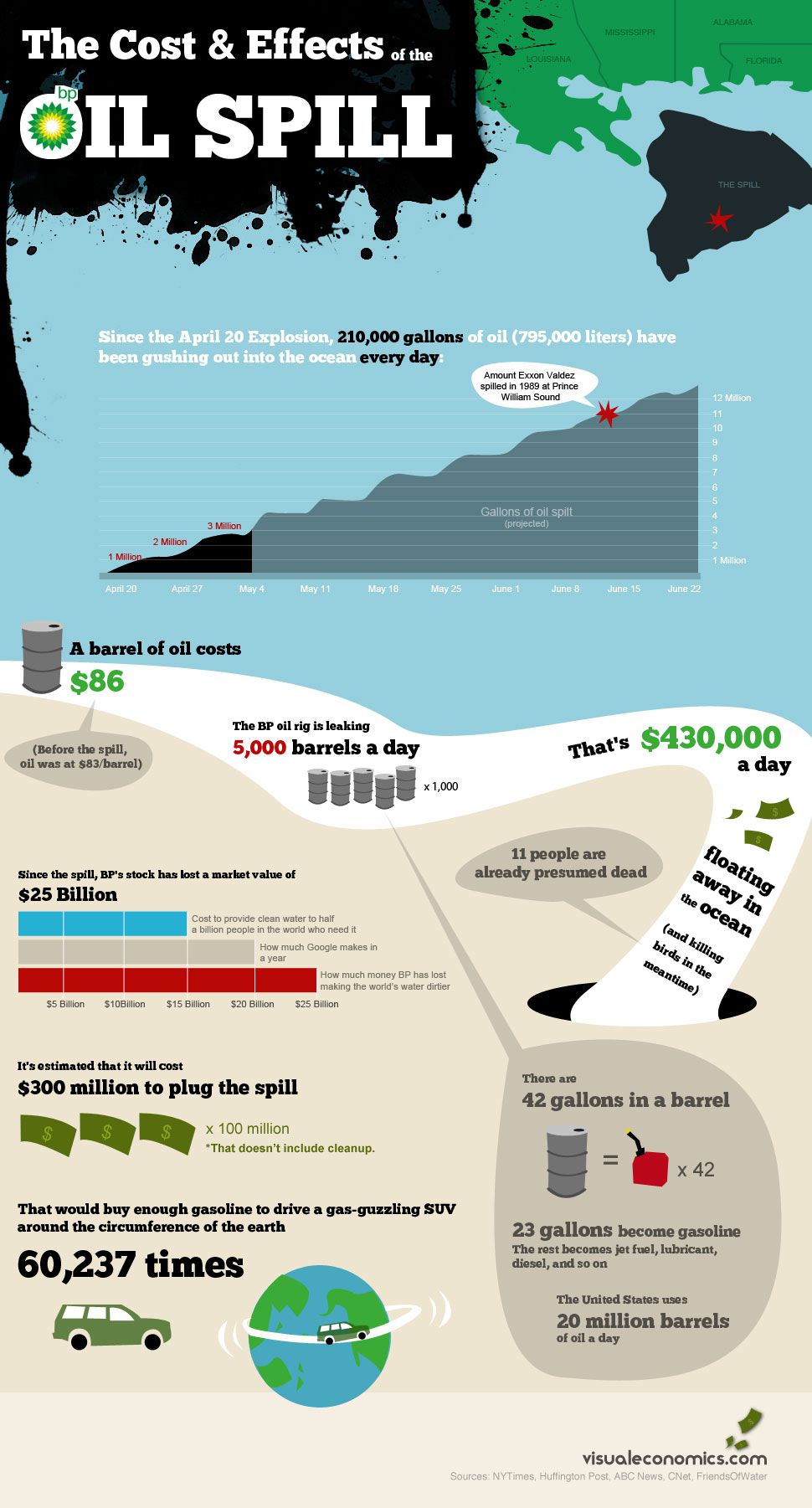
In the Yahoo News article, writer Brett Michael Dykes cites many of the negative effects of the oil spill and less on the bonuses to the Transocean executives.
In contrast, Reuter's headline for the same story reads, "Transocean execs giving safety bonuses to memorial fund." This headline provides a more objective perspective, thereby making the Transocean executives appear more humane in accepting the bonuses, without chastising them.
Several large companies have structured the payment of bonuses to their executives into their corporate culture, as evidenced when Lee Raymond, the former CEO of Exxon Oil retired in 2006, whose retirement package reached $400 million which included his pension, perks, stock options and more. The company justification is that it was for a “long and distinguished career.”
When BP Oil executives were awarded bonuses after the Deepwater disaster, the company defended the awards, saying that the two men “had hit their divisional targets.”(MacAlister, www.Guardian.co.uk, 2011)
In the case of the Transocean bonuses, although the company maintains that the bonuses were issued based on its "best year in safety performance", according to the Wall Street Journal, the executives donated the money to the fund developed to aid the families of the eleven workers who died in the explosion. According to Reuter's, more than $1.6 million had been distributed by the Deepwater Horizon Memorial Fund.
Opinions on the morality, business sense and strategic logic of the issuance of the Transocean bonuses has caused speculation about the rationality of the bonuses.
Transocean executives had the best safety record, on a statistical basis, than in many recent years. This was despite the loss of life and enormous damages incurred. In evaluating the number of incidents per year, the company found that the year 2010 had the lowest number on an incident basis. This is the criteria upon which the bonuses were issued. Had the company's criteria for bonuses been based upon the dollar amount or cost to the company in damages, then the same executives may well have lost their jobs, however, this was not the criteria.
Are the executives entitled to receive bonuses if their safety record meets the criteria for a bonus? Tell me what you think.
Sunday, April 24, 2011
Street Help for the Homeless...for the Children...
 |
| Source: Dreamstime.com |
Never before has the need for individuals to tap into their own resources to help others been heard more than in recent years. With people losing their homes, schools closing and the loss of jobs, more and more people are becoming homeless.
The faces that often get lost in the shuffle are children. It is amazing to me that, in 2009, approximately one in every fifty children in the United States was homeless (Gray, Time Magazine, 2009). Although many of them live in shelters with their parents, the fact is, they are still counted as being homeless by the standard definition.
 |
Nationally, the agencies and shelters indicate that to those who are homeless, the key elements missing in their lives are stability, self-esteem and safety.
In the years, 1999 through 2009, there were, nationally, forty-six attacks on homeless people, eighteen of which resulted in death. (National Coalition for the Homeless, 2009). Some attacks were by other homeless people suffering with various forms of mental illness and others were from substance abusers of those engaged in hate crimes.
In the years, 1999 through 2009, there were, nationally, forty-six attacks on homeless people, eighteen of which resulted in death. (National Coalition for the Homeless, 2009). Some attacks were by other homeless people suffering with various forms of mental illness and others were from substance abusers of those engaged in hate crimes.
 |
| Source: Nat'l Coalition for the Homeless (2009) |
People often forget that a large number of the homeless are families. If they are in a shelter, the family eats, the children get to attend school, the family receives mental health counseling, medical care, job training and even parenting skills, which all work to prepare them for redirecting their lives.
In Houston, Marilyn Fountain, of the Star of Hope mission feels that everyone can be of help, which may not always be monetary.
If, according to an African proverb, “It takes a whole village to raise a child,” then, according to teacher, G. Mebane, “Every child is part of a village and each person has a responsibility to help a child in some way.”
The challenge for the shelters in Texas is getting adults with, or without, children, to accept help.
The fact that homeless children are able to attend school, when living in a shelter, increases their opportunity for success. “Education opens a world for homeless children to escape from some of the ills of society” says Houston area psychology teacher, D. Williams.
The bottom line is that the shelters are a better alternative to the streets than not, for families and single adults, alike. Every person should do their part to assist those who are less fortunate because, at some point, any one of us could be in their place.
Subscribe to:
Posts (Atom)